
Theatre: a space where a performance takes place, in effect a large machine in the form of a building that is specialized for presenting performances.
Proscenium stage:
A proscenium theatre is what we usually think of as a "theatre".
Its primary feature is the Proscenium, a "picture frame" placed around the front of the playing area of an end stage.
The frame is the Proscenium; the wings are spaces on either side, extending off-stage. Scenery can surround the acting area on all sides except side towards audience, who watch the play through picture frame opening. This open side is sometimes referred to as the "fourth wall", as the other three walls consist of scenery. "Backstage" is any space around the acting area which is out of sight of the audience.
Thrust theatre:
A Stage surrounded by audience on three sides. The Fourth side serves as the background.
In a typical modern arrangement: the stage is often a square or rectangular playing area, usually raised, surrounded by raked seating. Other shapes are possible; Shakespeare's Globe Theatre was a five-sided thrust stage.
End Stage:
A Thrust stage extended wall to wall, like a thrust stage with audience on just one side, i.e. the front.
"Backstage" is behind the background wall. There is no real wingspace to the sides, although there may be entrances located there. An example of a modern end stage is a music hall, where the background walls surround the playing space on three sides. Like a thrust stage, scenery serves primarily as background, rather than surrounding the acting space.
Arena Theatre:
A central stage surrounded by audience on all sides. The stage area is often raised to improve sightlines.
Flexible theatre:
Sometimes called a "Black Box" theatre, these stages are often big empty boxes painted black inside. Stage and seating not fixed. Instead, each can be altered to suit the needs of the play or the whim of the director.
Profile Theatres:
Often used in "found space" theatres, i.e. theatres made by converted from other spaces.
The Audience is often placed on risers to either side of the playing space, with little or no audience on either end of the "stage". Actors are staged in profile to the audience. It is often the most workable option for long, narrow spaces like "store fronts".
Scenically, a profile theatre is most like an arena stage; some staging as background is possible at ends, which are essentially sides. A non-theatrical form of the profile stage is a basketball arena, if no-one is seated behind the hoops.
Sports Arenas:
Sports arenas often serve as venues for Music Concerts. In form they resemble very large arena stage (more accurately the arena stage resembles a sports arena), but with a rectangular floorplan. When used for concert, a temporary stage area often is set up as an end stage at one end of the floor, and the rest of the floor and the stands become the audience. Arenas have their own terminology; see below.
The Proscenium is the defining element of proscenium theatre. It is basically a big picture frame dividing acting space from the audience. All directions on the stage is defined according to this division of the space by the proscenium.
Stage directions are given from the viewpoint of an actor standing center stage while facing the audience, Stage Left is the actors left, Stage Right to the actor's right. Downstage is towards the audience, Upstage is towards the back wall of the stage. The Plaster Line (PL) is a line running from the back of one side of the proscenium arch to the other proscenium. The Center Line (CL) runs upstage/downstage half way between prosceniums and perpendicular to the Plaster Line. The point where the Center Line and the Plaster Line intersect is sometimes referred to as the "zero-zero" point. The location of everything on stage is measured from this intersection.
Everything downstage of the Plaster line is called Front of House, or FOH. Occasionally it is also called "Ante-proscenium" which means "before the proscenium". Anything the audience can see on the stage is on-stage. Anything on the stage but out of the audience view is off-stage or backstage. Wings are the sides of the stage, and the Fly Loft or Scene House is the space above the stage. The floor is called the Deck.
The part of the stage located downstage of the Proscenium is called the Apron, or sometimes the Thrust. The Audience seating is the Auditorium or the House.
Stage directions: L,C,R,US, DS etc., Plaster and Center Lines:
Proscenium, FOH, Wings, Apron, Traps and traproom:

Scene house, Fly loft, Lock rail, Fly rail, Loading rail, Grid
House, Box boom, Beams, Cove, Booth

Ancillary areas:
* scene and prop shops,
* storage,
* light storage and maintenance,
* costume shop and storage,
* dressing rooms, green room,
* lobby & box office, publicity, administration.
An Arena is designed for sporting events first. Setting up a concert means fitting it into a space meant for a different kind of event. Compromise and accommodation is frequently required.
The stage is usually set up as an End Stage, or occasionally in the center as an "Arena" Stage.
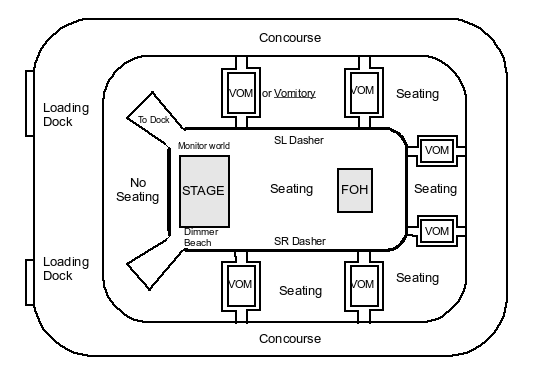
The Stage is usually set up at the Loading Dock end of the building for ease of setup. Opposite the stage is Front of House or FOH, sometimes called "Sound World", as the Mixing consoles are located here. Standard stage directions are usually used (Stage Right, Stage Left, Downstage, Upstage, etc.). The Monitor mixer often go SL in "Monitor World", and lighting dimmers go SR in "Dimmer Beach". The main floor at the Resch Center is designed as a hockey rink, and is surrounded by a protective wall called a Dasher, even during concerts. Seating is located on the main floor between the Stage and FOH, and also in the bleachers. Audience entrances from the concourses (lobby areas) into the seating bowl are called VOMs, short for "Vomitories", the old Roman name for such entrances.
Defining directions more problematic on these stages, as the audience isn't located in any single direction. Assigning direction can become rather arbitrary.
Thrust theatres:
The middle section of the three-sided audience is often defined as "downstage".
Care must be taken to remember the sides are also "downstage" from the viewpoint of the audience seated there.
Arena stages:
Assigning stage directions in an arena setting can be almost arbitrary, as all directions are "downstage" for some part of the audience. Proscenium style stage directions don't work well.
Common schemes used instead include:
* Compass directions (north, south,east, west) from center stage.
* "Clock" (12:00, 3:00, 6:00, 9:00) with direction of "12:00" assigned.
* Assign names to given parts of the stage space (e.g. Ar.A, Ar.B, Ar.C, etc.); areas
may be different in subsequent productions with different settings.
Any of these systems can work, provided everyone working on a production is familiar with the agreed upon scheme.