
7/08/11 edition
1. For what does I.A.T.S.E. stand?
2. With which branch of organized labor is IATSE affiliated?
3. If you were in charge of a job which required more hands, where and how would you get these additional hands?
4. If you were having trouble with the management on a job, or disagreed with the safety procedures you were asked to use, what would you do to straighten out the problem?
5. List the four primary contractual departments listed on a yellow card.
A._______________________B.____________________
C._______________________D._____________________
6. A new department has recently been added to the Yellowcard. What is it?
7. If you are going to be late or decide you can't make a call at the last minute, who should you contact and when, and in what order?
8. What resources do you have as a worker if you disagree with a department head or Steward on the job?
9. In what month is the official Local 470 election usually held?
10. How often does Local 470 have a general membership meeting?
11. How long are Local 470's officers elected to serve?
12. How much is currently withheld from Local 470 members' paychecks to pay for general expenses?
A. 6%
B. 5%
C. 2%
D. $35.00
E. None of the above
13. Explain the general concept of the Steward Bill of Rights.
14. True or False: If you cannot attend the meeting of the official 470 election, you will not have the opportunity to vote.
15. True or False. All negotiated contracts for wages, terms, and conditions are the same for all employers and all venues.
16. Local 470's "mother" office is located in ___________________________.
17. What three reasons are grounds for immediate dismissal from a job?
18. In what year was IATSE Local 470 founded? ______________________
19. What recourse do you have as a worker if you disagree with a warning or late fine issued to you by a Steward?
1. The first thing you do when you arrive at a jobsite is:
2. A "Trade Show" is:
3. Explain why it is important to be on time for a job:
4. The proper procedure for lifting is to lift with the:
5. The proper position for a Stagehand(s) to be in when pushing something up a ramp is:
6. Rigging ropes hanging from a Theatre grid should be:
7. When working with a fork lift, the responsibilities for safety fall on the:
SECTION 1
1) If your call time is 8:00 a.m., what time should you arrive for work?
2) What is the proper attire for a wardrobe person?
3) What are the tools a wardrobe person should carry on any call?
4) Your duties as a wardrobe worker are whatever you are assigned to do by the wardrobe supervisor or the department head, and you should be prepared for any task. What might some of these tasks include:
5) Define "underdress". What conditions determine when it is most useful?
6) Define a preset and its purpose. How can you identify a wardrobe preset backstage?
7) What is a drop cloth? When and why is it used?
8) How would you iron an unidentified fabric?
9) What is a press cloth? What is it's purpose?
10) How would you remove wrinkles from velvet without a steamer or pin board?
11) List two safety precautions when using a steamer.
a)
b)
12) Give examples of at least 3 things you should ask the wardrobe supervisor before you do any show laundry.
13) Describe the steps to follow in polishing a shoe:
14) List some of the proper procedures to follow when using Barge cement.
15) Describe a sleeve board. When and why are they used?
16) What is the correct way to zip a tight bodysuit?
17) How would you free a stuck zipper?
18) What is the purpose of dress shields (pit pads)? What are they?
19) Define the term "dead costume".
20) List 7 criteria all wardrobe show crew should be following while returning costumes to their "storage" location. (gondola, dressing room, quick change area, etc.)
a)
b)
c)
d)
e)
f)
g)
21) What is a "dresser track?"
22) When would you use a:
a) sewing machine?
b) serger/merrow/baby lock machine?
23) What is a continuity?
24) What duties must be performed by a worker in wardrobe to qualify for the premium "stitcher" pay on a work call?
For assistance in the tools and hardward section of this test the following books may be helpful:
Check at your local library in the non-fiction section under numbers 646.2 to 646.4
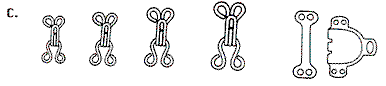
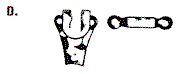
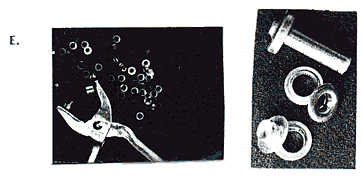
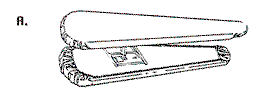
1. Identify the following items and describe their function.
 |
 |
 |
 |
 |
 |
2. Identify the following pressing aides and describe their function:
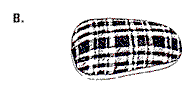

A.__________________________ / ____________________________
B.__________________________ / ____________________________
C.__________________________ / ____________________________
3. Identify the following beads:
 |  |  |
| A._____________________ | B.____________________ | C._____________________ |
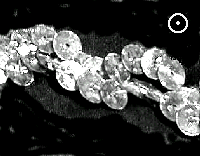 |  | |
D._____________________ | E._____________________ |
4. Identify the following buttons:
 |  | A._____________________ | B._____________________ |
5. Identify the following sewing tools and their purpose:

A. _____________________________________________________________________________

B. ____________________________________________________________________________

C. ____________________________________________________________________________
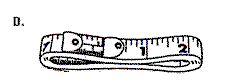
D. ____________________________________________________________________________

E. ____________________________________________________________________________
6. Identify the following pins:
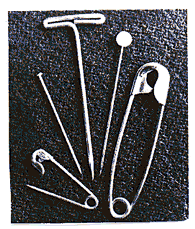 | A.____________________ B.____________________ C.____________________ D.____________________ |
| A---B---C---D---A |
HATS:
pork pie:
fedora:
pillbox hat:
boater or skimmer hat:
bowler:
newsboy cap
SHOES
Pumpst-straps
slingbacks
mary janes
espadrilles
patent leathers
chucks
wingtips
cap toe
LaDucas
capezios
WOMEN'S CLOTHES
crinoline
merry widow or bustier
cookies
reticule
MEN'S CLOTHES
double breasted suit
single breasted suit
French cuff
wingtip collar
cumberbund
dance belt
cod piece
1. Applicant should arrive for the exam as if it were a work call.
2. Applicant must sew the following onto designated fabric:
3. Applicant must demonstrate the ability to make emergency seam repair.
4. Applicant must give a brief discussion of the proper actions and demonstrate the ability to make a repair in the following situation: A zipper has just broken beyond repair, the actor has two minutes to entrance.
5. Applicant must assist an “actor” in making a quick costume change.
6. Applicant must be able to iron six unidentified fabrics in proper order and explain the order used (and any other precautions) when ironing the fabrics.
7. Applicant must show ability to operate a domestic sewing machine.
8. Applicant must show ability to fill and operate a clothes steamer. Applicant must show proper safety precautions, explain method(s) used to steam garment, and how to avoid damage to fabric.
9. Applicant must polish a pair of dress shoes with paste polish.
10. Applicant must demonstrate different hand sewing stitches, such as cross-stitch, couch (a/k/a vertical hem) stitch, whipstitch, blind hem stitch.
11.) You will be given a very wrinkled dress shirt and allowed 8 minutes to iron it.
12.) Tie a man's tie (either on yourself or on another person) in a basic half-windsor.
Applicant must discuss the following:
13.) You need to use a product that requires ventilation. You do not have any prearranged area for this. What precautions/place do you use?
14.) Other than ventilation, what precautions do you use when applying and “curing” Barge Cement?